


The Alberta government says changes to the collection of education property taxes will save property owners nearly $100 million next year.
Through Budget 2027, the government says it will introduce one provincial education property tax rate that will be set for three years at a time, allowing Albertans and municipalities to better plan for the years ahead.
The new standardized EPT rate is expected to reduce taxes paid by Alberta property owners, delivering an estimated overall savings of $98.7 million in 2027-28.
“We are giving Albertans and municipalities a clear rate they can plan around and helping put more money back in families’ pockets,” says Finance Minister Jason Nixon. “Locking in one rate for three years brings discipline and certainty to how this tax works, and it means stable, sustainable funding for classrooms across the province.”
Nixon says the change is about providing clarity and consistency.
“Currently rates vary from town to town and the rates we announce in the budget don’t match the rates you find in your mailbox — that does not pass the clarity test,” says Nixon.
For properties where the new provincial rate may be higher than their current local rate, the government says it will offer a one-time transition tax credit in 2027 to help bridge the gap.
The change, he says, is part of the government’s effort to keep Alberta the lowest-taxed jurisdiction in Canada.
Nixon also clarified that the change would not reduce the commitment announced in Budget 2026-27 to build more schools and hire more teachers to support some 80,000 new students in the province since 2021.
Responding to reporters’ questions, Nixon said any shortfall would be absorbed through general revenue.
Under the new EPT, the provincial education property tax rate will be set at $2.65 per $1,000 of assessment for residential and farmland properties.
The non-residential rate is set at $3.98 per $1,000 of assessment.
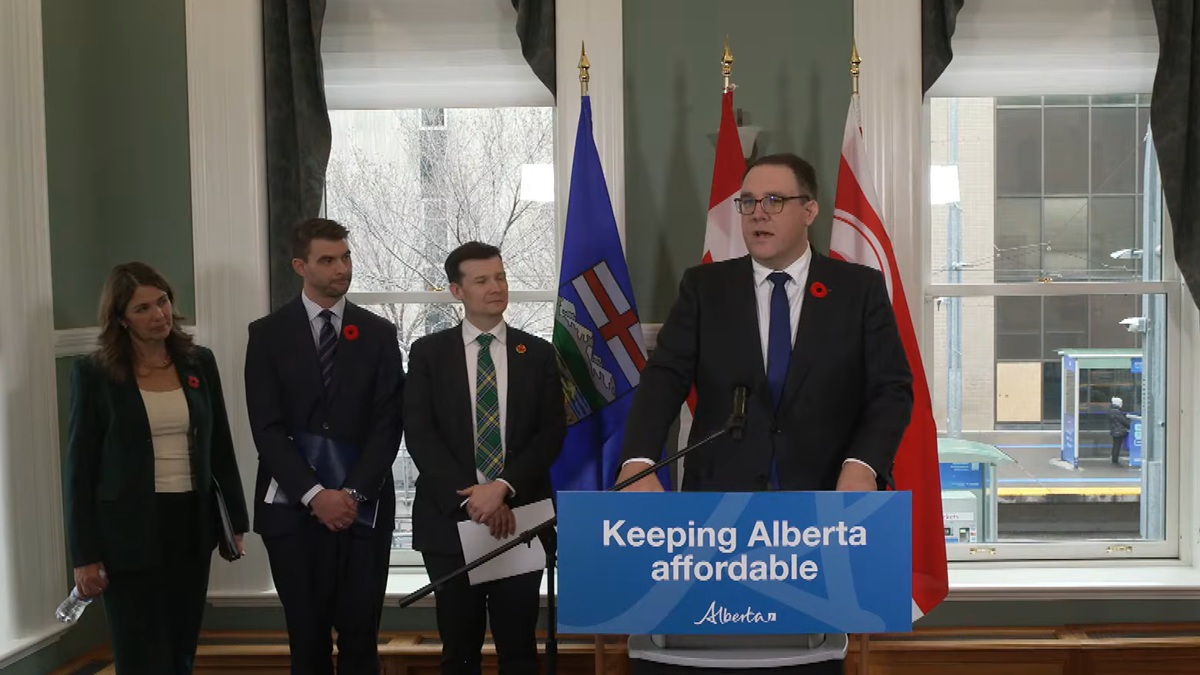
Speaking at the Oct. 30 announcement in Calgary, Premier Danielle Smith thanked municipal leaders, including Calgary Mayor Jeromy Farkas, for bringing the issue of rising education property taxes to the government’s attention.
Municipal Affairs Minister Dan Williams concurred, also crediting the City of Edmonton for its advocacy on the issue. The new “flat rate” education tax will show up on spring 2027 tax bills, he adds.
Farkas praised the announcement, calling it a “generation leap” in fairness and transparency for Calgarians and all Albertans. He expects the change in education property taxes will allow Calgary to offer a lower-than-expected property tax increase while investing in infrastructure, housing and public safety.
NDP says government misses the mark on affordability
A statement from NDP leader Naheed Nenshi says an education property tax freeze does very little to help Albertans.
“Last year, the province increased property taxes for the average Calgary home by over $350. Today, the UCP announced they will reduce that increase by a maximum of about $75 – for houses that don’t go up in value at all,” says Nenshi in a provided statement. “This year, they’re paying for this by shifting that property tax burden to rural homeowners who would see increases. But conveniently, only after the next election date.”
The opposition leader also accused the UCP of downloading costs on municipalities which he says has driven property taxes higher.
The UCP, he says, has consistently voted down every single NDP proposal to reduce grocery prices, the cost of housing, and other costs.
Nenshi also criticized the government for “wasting hundreds of millions on a divisive referendum that only their separatist pals wanted.”
Town of Rocky Mountain House advocates for reform
The issue of rising education property taxes has been a focus for the Town of Rocky Mountain House.
While not advocating for a reduction in the tax, the town has instead been lobbying the Alberta government to separate the education levy from regular municipal tax bills.
The hope was that the change would reduce confusion for taxpayers, as residents have raised concerns about rising school taxes on their municipal tax bills — something outside the control of towns, villages and cities.
The town brought the issue to the 2025 Alberta Municipalities conference in Calgary by sponsoring a motion calling for the province, rather than municipalities, to collect the tax.
The motion was supported by 86 per cent of delegates at the convention.
However, at the Oct. 30 announcement in Calgary, Nixon clarified that municipalities will continue to collect the tax on behalf of the province, and there will be no additional administrative burden.
–
RELATED
–





Comments