



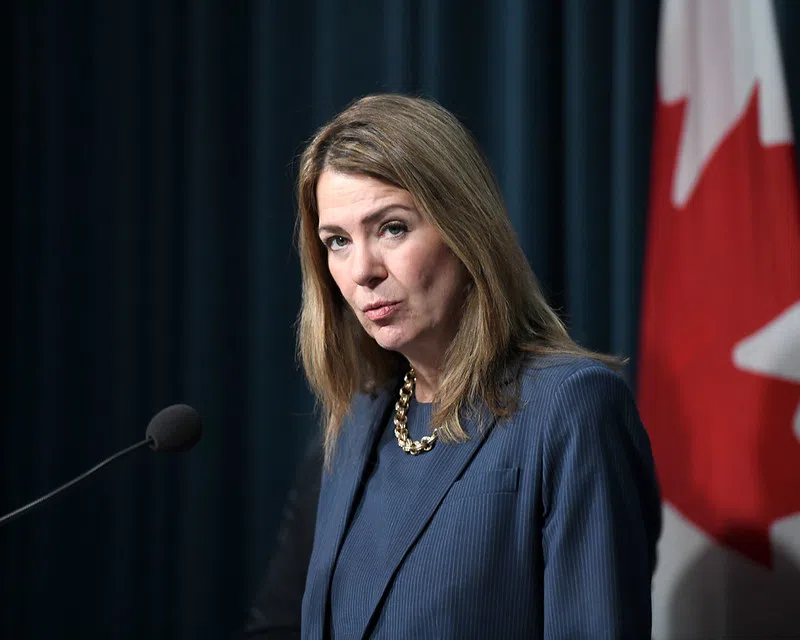
During a televised address on Thursday, Feb. 19, Premier Danielle Smith announced a series of referendum questions regarding immigration, public services, court justices, provincial-federal jurisdiction, and more.
She says it is “an exciting time for our province,” with a booming economy, a Memorandum of Understanding to build a new pipeline to the west coast, and “tens of billions” in new projects recently announced.
At the same time, Smith warns that Alberta is facing a “very serious growth and budget challenge that must be addressed.”
The premier called out the “disastrous open border immigration policies” of former Prime Minister Justin Trudeau, which she says have caused an unprecedented strain on our health care, education and social programs.
“In just the last five years of Trudeau’s tenure, Alberta grew by almost 600,000 people to more than 5 million, all while Ottawa throttled our most important job-creating industries and prioritized immigration away from economic migrants and instead focused on international students, temporary workers and asylum seekers,” says Smith.
She adds, “Although sustainable immigration has always been an important part of our provincial growth model, throwing the doors wide open to anyone and everyone across the globe has flooded our classrooms, emergency rooms and social support systems with far too many people, far too quickly.”
At the same time, the price of oil has fallen by more than $30 per barrel since Smith was sworn into office in 2023 to around $60.
According to her, for every one dollar that oil prices fall, Alberta receives roughly $750 million less in oil royalties. She says this has resulted in an $11.6 billion surplus in 2023 at $90 per barrel, turning into large deficits now at $60.
“To sum up our budget challenge – low oil prices combined with out-of-control federal immigration policies are together driving unsustainable budget deficits – not just here but across the country,” says Smith.
She had recently announced that the next provincial budget, set to be delivered on Thursday, Feb. 28, will include “significant deficits” as a result of these challenges.
Her solution is a three-part strategy to address the budget challenge without resorting to what she calls “deep and disruptive cuts to core social services.”
The long-term strategy was announced last year, which was to build the Alberta Heritage Fund to more than $250 billion by 2050. Smith says the trust fund can help to weather any short-term dips in oil and gas revenues.
“When we reach this goal, Alberta will be forever free from its over-reliance on oil and gas revenues. We need to stay the course.”
The medium-term strategy is to double Alberta’s oil and gas production and exports to more than eight million barrels per day by 2035. According to Smith, a major part of this will be to continue working on implementing the new energy deal with Ottawa, which includes the proposed pipeline to the Pacific coast.
As for Alberta’s short-term plan, the premier says she needs to get the support of voters first.
Smith assures that her government will “not be implementing drastic cuts to social services,” and that approved wage increases for doctors, nurses and teachers will remain in place.
Her strategy revolves around cutting “unnecessary bureaucracy,” improving efficiencies in program delivery, and prioritizing needs before wants as much as possible.
To accomplish these goals, Smith has announced nine provincial referendum questions that will be voted on on October 19, 2026.
Albertans will be asked the following questions:
- Do you support the Government of Alberta taking increased control over immigration for the purpose of decreasing immigration to more sustainable levels, prioritizing economic migration and ensuring Albertans have first priority to new employment opportunities?
- Do you support the Government of Alberta introducing a law mandating that only Canadian citizens, permanent residents and individuals with an Alberta-approved immigration status will be eligible for provincially funded programs, such as health, education and other social services?
- Assuming that all citizens and permanent residents continue to qualify for social support programs as they do now, do you support the Government of Alberta introducing a law requiring all individuals with a non-permanent legal immigration status to be resident in Alberta for at least 12 months before qualifying for any provincially funded social support programs?
- Assuming that all citizens and permanent residents continue to qualify for public health care and education as they do now, do you support the Government of Alberta charging a reasonable fee or premium to individuals with a non-permanent immigration status living in Alberta for their and their family’s use of the healthcare and education systems?
- Do you support the Government of Alberta introducing a law requiring individuals to provide proof of citizenship, such as a passport, birth certificate, or citizenship card, to be eligible to vote in a provincial election?
Smith says the next four questions are aimed at strengthening Alberta’s constitutional and fiscal position within a united Canada.
Do you support the Government of Alberta proactively working with other willing provinces to amend the Canadian Constitution in the following ways:
- Have provincial governments, and not the federal government, select the justices appointed to provincial King’s Bench and Appeal courts.
- Abolish the unelected Federal Senate.
- Allow provinces to opt out of federal programs intruding on provincial jurisdiction such as health, education, and social services, without losing any of the associated federal funding for use in their own provincial social programs.
- Better protect provincial rights from federal interference by giving a province’s laws dealing with provincial or shared constitutional areas of jurisdiction priority over federal laws when in conflict with one another.
By David Opinko, LethbridgeNewsNOW.





Comments